
Showing posts with label Art. Show all posts
Showing posts with label Art. Show all posts
January 26, 2012
Faber-Castell portraits

How amazing are these Faber-Castell ringed black & white portraits by Chan Hwee Chong created using Faber-Castell’s PITT Artist Pens? The artist uses only the pressure of the pen with a continuous line until the portrait is finished.
Read more at Design Milk: http://design-milk.com/page/42/#ixzz1kb9Jxy7C
Read more at Design Milk: http://design-milk.com/page/42/#ixzz1kb9Jxy7C


January 21, 2012

October 16, 2011


June 7, 2011


May 28, 2011



May 5, 2011
April 25, 2011
April 6, 2011
Guten morgen Tante Resi

Guten Morgen Tante Resi / © Florian Aschka
"My name is Tante Resi, I was born in May 1919 near Passau (Bavaria). I'm a great fan of my red puddle astrid, she is really sweet. When i was younger I liked very much to travel with my husband to Ischia, a very nice island. We spent their a lot of weeks specially in wintertime when it was too cold in Germany. I have a big interest to become immortal... but apart from this things I'm interested in all kind of rumours in my village and of course shopping is a big thing in my life... since 2003 I'm making art with my grandnephew Florian Aschka"


March 22, 2011


March 7, 2011
Peter Callesen!


Peter Callesen is a Danish artist and author. Callesen is renowned for his exceptional talent in combining the minimalism of a big crisp white sheet of paper with the complexity of meticulously cut and folded paper and uses the two to build out some really beautiful compositions. Particularly noteworthy are his works where the remains of the cut and folded objects are literally shadows of the objects former self. He uses the positive and negative space to tell a sometimes-dark story about the past and future of his subject using only a white sheet of paper.
He creates intricate papercut artwork from A4 paper and in large-scale installations. Each work is created from one sheet of paper, be it three-dimensional flowers falling from a bouquet's negative, a hummingbird flying from the page, or a child-size castle crafted from a billboard-sized paper. He uses paper because he says it is "probably the most common and consumed media used for carrying information today," but we "rarely notice the actual materiality" of it. There is a tragic quality to most of his subjects, whether it's a flower dying, an angel locked in a birdcage, or even an apple reduced to its core. So the frail and delicate paper medium underlines that element of calamity.
He says: "The paper cut sculptures explore the probable and magical transformation of the flat sheet of paper into figures that expand into the space surrounding them. The negative and absent 2 dimensional space left by the cut, points out the contrast to the 3 dimensional reality it creates, even though the figures still stick to their origin without the possibility of escaping. In that sense there is also an aspect of something tragic in many of the cuts".
I´m totally amazed by this man´s work! Check him out here!
I´m totally amazed by this man´s work! Check him out here!
November 5, 2010


August 16, 2010
Cut room.
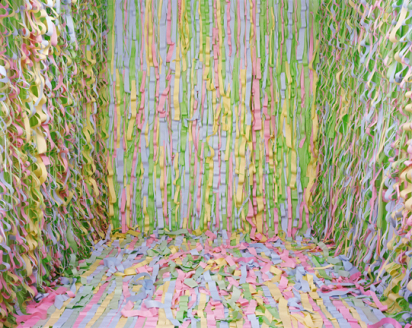
Gina Osterloh is behind this installation. It´s great! Via Design for mankind


July 31, 2010
100 chairs in 100 days


Exhibition: 100 Chairs in 100 Days by Martino Gamper 5 Cromwell Place, London 2–15 October 2007
Martino Gambers says: This project involves systematically collecting discarded chairs from London streets (or more frequently, friends’ homes) over a period of about roughly two years, then spending 100 days to reconfiguring the design of each one in an attempt to transform its character and/or the way it functions. My intention is to investigate the potential for creating useful new designs by blending together stylistic or structural elements of existing chair types.I see this as a chance to create a ‘three-dimensional sketchbook’, a set of playful yet thought-provoking designs that, due to the time constraint, are put together with a minimum of analysis. As well as possibly making one or more designs that might be suitable for mass production, I intend to question the idea of there being an innate superiority in the one-off, to use this mongrel morphology to demonstrate the difficulty of any particular design being objectively judged ‘the best’. I also hopes my chairs illustrate – and celebrate – the geographical, historical and human resonance of design: what can they tell us about London, the sociological context of seating from different areas, and the people who owned each one? The stories behind the chairs are as important as their style or even their function.
The project suggests a new way to stimulate design thinking, and provokes debate about a number of issues, including value, different types of functionality and what is an appropriate style for certain types of chair – for example, what happens to the status and potential of a plastic garden chair (conventionally located slap bang in the idiom of unremarkable functionality) when it is upholstered with luxurious brown suede? In essence, this exercise champions a certain elasticity of approach – both in terms in highlighting the importance of the sociological/personal/geographical/historical context of design, and in enabling the creative potential of elements of randomness and spontaneity to be brought to the fore.
M.G
June 26, 2010


June 12, 2010


Subscribe to:
Posts (Atom)

